The Ghost in the Grid: The Unseen Crucible of Real-Time Monitoring

Welcome to The Acheron Outpost.
If you climb to the jagged crags of Caelus Prime, all you will see is a bleak, unforgiving desert of shifting methane ice and howling storms that scream at minus one hundred and forty degrees Celsius. But look down, far past the frozen mantle, and you will find a sprawling labyrinth of subterranean geothermal extraction tunnels. Here, three miles beneath the ice, is a closed-loop pressure grid that keeps three thousand colonists alive.
The heat, the oxygen, the atmospheric pressurization—everything is regulated by the Geothermal Core. And at the heart of this technological oasis lies the Operations Floor: one hundred and fifty technicians sitting in semi-darkness, their faces bathed in the cool blue glow of holographic interfaces.
Most senior managers look at this floor and see a standard workforce. They see units of production, a simple linear machine of inputs and outputs. But if you walk past the rows of workstations, past the hum of the cooling racks, and step up the steel steps of the glass box hanging from the cavern ceiling, you enter the Nerve Centre.
This is the home of Kaelen Vance, Lead Real-Time Administrator (RTA).
Kaelen doesn’t see technicians, and he doesn’t see ice. He sees the outpost as a living, breathing mathematical organism. He sees thirty-minute intervals, distribution curves, and the invisible ebb and flow of human capacity. He is the atmospheric regulator of the outpost, and his weapon of choice is a terminal running real-time status monitors and queue diagnostics.
For most corporate operations, Real-Time Monitoring (RTM) is treated as a glorified stopwatch—a tactical, robotic exercise in micromanagement. But in Kaelen’s world, RTM is the difference between survival and sudden, icy decompression.
This is the story of how Sector 4 almost froze to death, not because of a mechanical failure in the geothermal vents, but because of a catastrophic, invisible collapse of the human grid—and how the WFM team had to perform emergency surgery to bring the outpost back to life.
Chapter 1: The Crimson Board and the Erlang Illusion
The trouble began on day 84, right at the transition of the mid-day shift.
Director Mara Thorne was a legend in the operations department. She had climbed the ranks from a field engineer to Operations Director of Sector 4 by sheer force of will. She was professional, authoritative, and wore her stress like a badge of honor. But Mara had one fatal flaw: she was a manager who believed that every operational crisis could be resolved by cracking a louder whip.
At 13:15, a pressure pocket shifted in Vent Sector B. The "Venting Logs" (our equivalent of inbound customer calls) spiked by 40%. On the massive holographic wallboard hanging over the operations floor, the Service Level (SLA) — usually a pristine green target of 92% of vents stabilized within 20 seconds — began to bleed.
Within minutes, the SLA plummeted to 42%. The "Awaiting Action" counter ticked up like a bomb.
Mara stormed up the steps into the RTA glass box, her boots clanging against the grated steel. Her face was as red as the wallboard.
"Vance!" she yelled, pointing through the glass at the floor.
"The board is bleeding! Why are we dropping vents? I see three technicians in the break lounge right now!"
Kaelen didn't look up from his monitor. He was watching the Occupancy Rate for Sector 4. It was sitting at 96%.
"Those three technicians have been on a continuous twelve-hour rotation, Director," Kaelen said, his voice flat, candid, and entirely devoid of corporate sugar-coating.
"They are on their scheduled fifteen-minute thermal recharge. If I pull them back now, their cognitive decline will cause a 30% error rate in vent alignment."
"I don't care about their cognitive decline!" Mara snapped.
"Cancel all recharges. Cancel all lunches. Update the schedule on the system and force everyone onto the active queue. Now!"
Kaelen finally turned his head, his eyes cold. "Mara, canceling lunches is a mathematical illusion. You aren't adding capacity; you’re just front-loading a car crash."
To understand Mara’s panic — and Kaelen’s resistance — you have to understand the Erlang C Illusion.
Most operations managers treat staffing as a simple division problem:
"I have 100 vents to align, each takes 5 minutes, so I need X people."
But call and event arrivals are not linear; they are random, Poisson-distributed clusters of demand. To account for this randomness, WFM relies on the Erlang C equation to calculate the Net Required FTE to meet an SLA target:
Using the standard Excel Erlang add-in that Kaelen and his WFM Planner, Lexis Carter, had compiled back in the planning phase, the math for this interval was clean:
21 Agents
They needed 21 Net Agents physically available at their terminals to protect the queue. But Mara’s scheduled floor only had 18 active technicians because she had approved a late-notice team meeting without consulting the weekly Look Ahead Report.
To bridge this three-agent deficit, Mara believed that canceling breaks would save the day. But here is the pragmatic reality: when you cancel breaks, you push your Occupancy Rate into the "Red Zone" (sustained levels above 85%–88%).
In Kaelen's dashboard, the occupancy line had been redlining for three hours. When humans are forced to work at 96% occupancy, two things happen with absolute, mathematical certainty:
- Average Handle Time (AHT) Bloat: Tired operators work slower.
- System navigation that usually takes 20 seconds stretches to 45 seconds.
- AHT balloons from the baseline of 250 seconds to 310 seconds.
- The "Power of One" Deficit: Because AHT increased to 310 seconds, the Erlang C algorithm shifted.
- Suddenly, to handle the exact same 113 vents, the outpost didn't need 21 agents — it needed 25 Net FTE.
By forcing exhausted technicians to stay on the floor, Mara’s "whip" had actually increased the staffing requirement by four people due to AHT fatigue. She was trying to fight a math problem with a hammer, and the numbers were winning.
Chapter 2: Silas and the "Patient Zero" Protocol
By 14:30, Sector 4 was in a full-blown "Zombie Syndrome" spiral.
The schedules were mismatched, the arrival patterns were completely skewed, and the floor was in "Zombie-Mode" — technicians were moving like the undead, staring blankly at flashing alerts while the system slowly rotted from the inside.
Kaelen Vance sat back in his chair. "Lex," he said to his planner, who was frantically running retro-forecast validation models.
"We have a leak. The schedule says we have 22 scheduled technicians on the floor. Erlang says we only need 21. Even with the AHT bloat, the queue shouldn't be backed up this bad. Where is the active FTE?"
"I'm looking at the login logs now," Lex replied, cracking his knuckles over his keyboard. "We have the headcount present at work, but the Average FTE Logged In — the actual productive capacity assisting the queue — is sitting at a miserable 14."
Kaelen narrowed his eyes. "We have a Patient Zero."
In Workforce Management, "Patient Zero" is the term Kaelen used for an agent or technician who finds a loophole in the schedule to avoid work. Once one person does it to survive, the behavior spreads like a viral infection through the floor until the entire plan is ruined.
Kaelen drilled down into the individual performance and conformance reports. He sorted the data by auxiliary states and time-in-code.
And there he found him: Silas Vance (no relation to Kaelen, though they shared the same dry, dark-humored pragmatism).
Silas was a veteran senior technician. He was highly competent, capable of resolving complex critical core vent alignments in under 180 seconds when the baseline was 250. But Silas was currently logged into "Aux 4: System Calibrations" — an off-queue administrative code designed for diagnostic testing.
He had been in that code for 42 minutes during the peak of the pressure surge.
"Silas has been offline for almost an hour," Lex whispered.
"If we pull his historical trend, his schedule adherence is usually a perfect 95%. What is going on?"
Kaelen didn't fire Silas, and he didn't write an angry message to his manager. Instead, he did what any master WFM professional does: he looked for the why behind the numbers.
He pulled Silas’s individual Workload and Occupancy Trend for the past three weeks. The story in the data was clear, and it was brutal:
- Silas had been scheduled on the grueling "Graveyard" shift for two consecutive weeks.
- Because of short-staffing in his specific product category (high-pressure geothermal brands), his daily occupancy rate had averaged 94.5%.
- He had worked a total of 18 hours of forced overtime over the past week.
- To make matters worse, Silas's daughter was back on Earth, suffering from a severe case of respiratory dust-lung, and his mind was three planets away.
Silas wasn't lazy. Silas was burning out. He was sitting in "Aux 4" because his brain was redlining, and he had hit his absolute physical and mental limit. He was practicing "System Manipulation" — using an administrative loophole to gain unofficial, unauthorized "time off" just to catch his breath and keep his sanity.
"Mara is driving them to hide," Kaelen said, his voice dropping an octave.
"When you push occupancy past 88%, your best people will turn into Patient Zeroes just to survive. They will extend their wrap-up times, they will linger in admin codes, and they will rush their active work, which is why the crop quality in the agricultural cavern failed last week."
He pointed to Silas’s record and said
"Silas is the symptom and Mara’s scheduling is the disease."
Chapter 3: The ACD Menu "Maze" and the Transfer Trap
Just as Kaelen was preparing to address Silas's burnout, the alarms in Sector 4 shifted from a dull amber to a flashing, high-frequency white.
"Now what?" Lex muttered, staring at a massive surge of internal routing alerts on his screen.
"Look at the transfer rate," Kaelen said, his fingers flying across his diagnostic terminal.
"It's spiking. The internal transfer volume between Sector 4 (Geothermal Vents) and Sector 2 (Life Support Systems) has gone vertical."
This was the second hidden challenge of RTM: The Transfer Trap.
Two weeks prior, the outpost’s IT department, acting entirely in isolation without consulting the WFM team, had implemented an "Operational Improvement" to the Automated Communication Distributor (ACD). In an attempt to "simplify" the customer journey for colonists reporting sector anomalies, they had merged several specialized skill queues into a single "Universal Operator" skill.
On paper, it looked like a clean, beautiful corporate slide deck. They told senior leadership it would "optimize resource utilization".
But in reality, it was an absolute disaster:
- Technicians who were highly trained in simple, low-pressure residential heating (the equivalent of selling "add-on benefits") were suddenly receiving super-critical core thermal-runaway alarms (complex products).
- Because they lacked the specialized training and product knowledge, these operators were terrified of making a catastrophic error that would vent Sector 4 into the vacuum.
- Their immediate reaction? Transfer the call.
Kaelen pulled the ECH (External Call History) database records to run a comparative "Before and After" analysis of the ACD change. The data was damning:
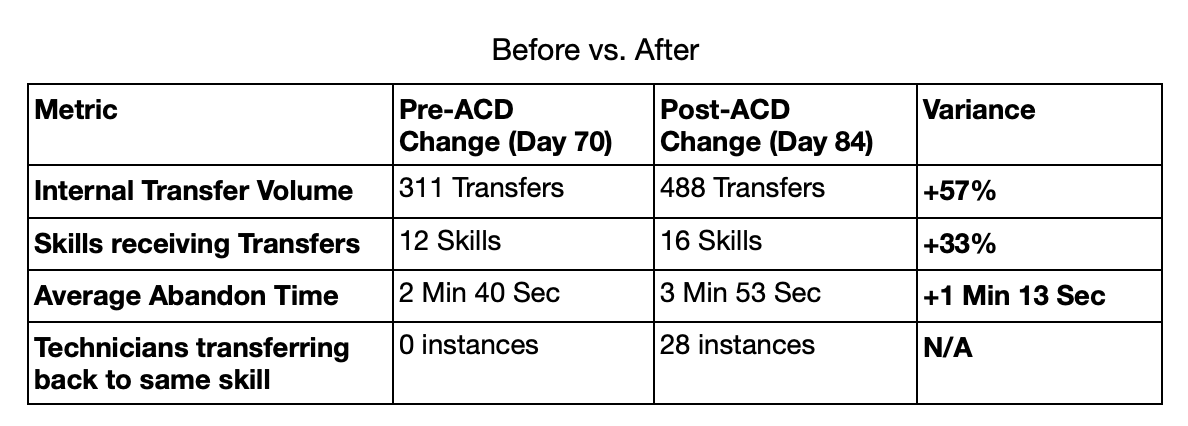
"Look at this, Lex," Kaelen said, pointing to the transfer matrix.
"Technicians are so lost they’ve literally transferred 28 critical core alarms back into the exact same skill queue they just came from. They are playing hot potato with life-support vents because they don't know how to resolve them."
This massive transfer loop had created an artificial "phantom workload." The inbound volume hitting the queue was 35% to 40% higher than forecasted, not because more things were breaking, but because the same critical alarms were being transferred round and round like a merry-go-round from hell.
The legacy database required technicians to manually transcribe every single comment and transfer reason into a clunky free-text field. Kaelen’s recent Time and Motion Study had revealed that this post-interaction administrative work — what WFM calls After Call Work (ACW) — was eating up a staggering 52.87% of the technicians' entire shift.
Because they were spending more than half their time typing out transcripts, they couldn't take the next alarm in the queue.
Mara Thorne’s response to this bottleneck was to cancel lunches. But Kaelen knew that no amount of canceled lunches could fix a broken routing design and an untrained workforce. The technicians weren't being lazy; they were being set up to fail by a system that expected them to be universal geniuses without the training to back it up.
Chapter 4: The Outcast's Cure — Ground Rules for the Frozen Frontier
At 15:30, Kaelen Vance walked out of the RTA glass box. He didn't bring a whip; he brought a tablet loaded with the ECH transfer analysis, the time study data, and a clear, pragmatic strategy.
He met Mara Thorne in the middle of the crowded, noisy operations floor.
"Mara, we are shutting down the shift meeting and reinstating the scheduled recharges immediately," Kaelen said, his voice quiet but carrying the absolute weight of mathematical certainty.
Mara gasped, her eyes wide. "Are you insane, Vance? The Service Level is at 41%! The colony is going to freeze!"
"No, Mara. The colony is going to freeze if you keep running this floor like a coal mine," Kaelen replied, turning his screen so she could see the data.
"Look at this screen. Silas Vance has been offline in 'Aux 4' for an hour because his occupancy is at 94.5%. He is physically exhausted. Look at your transfer rate — it's up 57% because your team is bouncing vents they aren't trained to handle. Your AHT has bloated by 60 seconds because your technicians are too tired to navigate the legacy interface. You are trying to squeeze blood from a stone, and the stone is cracking."
Mara stared at the numbers. The charts didn't lie. The comparative analysis of scheduled vs. actual logged-in FTE showed a massive, yawning gap where her "management by raw authority" had completely broken the WFM plan.
"So what do we do?" she asked, her voice finally losing its defensive edge. "I can't just let the vents fail."
"We don't let them fail," Kaelen said. "We stop treating WFM as a spreadsheet of suggestions and start treating it as a process of risk mitigation."
Together with Lex, Kaelen laid out the Four Pillars of the Real-Time Cure:
- Enforce the Occupancy Cap (82%–85%)
"We are capping planned occupancy at 82% to 85%," Kaelen commanded. "Sustained occupancy above 88% is operational suicide. By scheduling micro-breaks and optimized lunch windows to match the actual workload demand curves, we give technicians' brains time to cool down. This will immediately drop our AHT back to 250 seconds, reclaiming four FTE worth of capacity without hiring a single new resource."
- Implement the WFM Governance Framework (OLA)
"Operations and WFM are signing a binding Operational Level Agreement (OLA). Operations managers no longer have the authority to arbitrarily pull technicians off the queue for meetings, coaching, or training during peak workload intervals. All off-queue activities must be approved by the RTA team at least 48 hours in advance based on the weekly Look Ahead Report. If Ops violates the plan, the variance and the resulting SLA drop go directly onto their scorecard, not ours."
- Establish the Geothermal "Condition Level" Protocol
"In the event of a technical outage or sudden pressure spike, we don't scramble," Lex explained, pointing to their new Disaster Recovery framework:
- Condition Level 1 (High Severity):
- Move technicians from the late "Sub-Peak" shift (17:00–20:00) into the early "Peak" shift (08:00–17:00) for the next two days to handle the volume surge. Penalty costs for shift adjustments will be allocated based on who caused the downtime.
- Condition Level 2 (Medium Severity):
- Offer technicians reduced, optimized lunches to leave 30 minutes early on a subsequent "quiet" days.
- Condition Level 3 (Low Severity):
- Cancel all non-essential off-phone activities (meetings, one-on-ones) and assign one Team Manager exclusively to real-time adherence tracking on the floor.
- Streamline the Legacy Interface (Reclaiming Workable Time)
"We are going to IT to resolve the legacy comment screen bottleneck," Kaelen said. "We must reduce the time spent on 'Capturing Comments' by introducing drop-down categorical codes rather than requiring manual long-form transcription. If we can reduce that ACW segment by just 3 minutes, we reclaim 12% of lost workable time, increasing our overall capacity and stabilization potential by 9%."
Chapter 5: The Verdict: Reclaiming the Cavern
It took three days to implement the changes, and the results were nothing short of a miracle.
With scheduled breaks restored and planned occupancy capped at 83%, the floor’s atmosphere shifted immediately. Silas Vance returned to the floor, his eyes clear and his focus sharp. Because he was no longer taking back-to-back pressure hits, his individual AHT dropped from 310 to an incredible 230 seconds — well below the baseline. He was no longer a Patient Zero; he was once again Sector 4's top-performing asset.
The ECH transfer rate dropped by 19% as the WFM team helped re-design the ACD routing, sending specialized alarms only to skilled technicians and sending out a simple, clear call-flow map to show operators how to navigate the new system.
The bleeding on the wallboard stopped. The Service Level stabilized at a consistent, sustainable 92.5%.
Mara Thorne walked up the stairs of the glass box on day 87, carrying two mugs of real Earth-grown coffee. She placed one on Kaelen’s desk.
"You were right, Vance," she said, looking out over the green lights of the operations floor. "I thought I was driving efficiency by canceling breaks. In reality, I was just driving my best people into hiding."
Kaelen took a sip of the warm coffee, his face expressionless but his eyes showing a rare glint of satisfaction.
"WFM isn't a whip, Mara," Kaelen said, turning back to his diagnostic terminal. "It's a compass. If you try to run your team without it, don't be surprised when you find yourself lost in the ice."
Real-World Takeaways for Corporate Leaders
At Outpost WFM, we don’t just write stories to entertain; we write them to expose the raw, unspoken truth of contact center operations. The fictional crucible of The Acheron Outpost is played out every single day in corporate centers across the globe:
- The Micromanagement Myth:
- Real-Time Monitoring is not about watching your agents like a hawk to catch them being late by two minutes.
- It is about Real-Time Agility — being able to steer the car before you enter the bend, rather than looking at a crash report at the end of the month.
- The Burnout Math:
- High shrinkage and high absenteeism are rarely just "HR statistics."
- They are WFM statistics.
- When your real-time execution forces occupancy levels to redline, you are actively writing a prescription for unplanned shrinkage, high attrition, and system manipulation.
- The Governance Imperative:
- WFM is a control system designed to deploy resources effectively. If your operations department treats schedules as "suggestions" and allows unauthorized off-queue activities, they are rendering the entire WFM plan invalid and actively destroying your business’s bottom line.
Stop managing your center in "Zombie-Mode."
Stop trying to fix mathematical capacity deficits with disciplinary whips.
Learn your business, respect the math, protect your people, and turn your operation into an Outpost of efficiency.
Ready to perform a surgical audit on your operations floor and eliminate the invisible rot?
Every contact center is a unique ecosystem of data, technology, and human behavior. If you’re ready to stop fire-fighting and start building a high-performance WFM engine that protects both your Service Levels and your staff sanity, reach out to me directly for a professional consultation.


Member discussion